Free knowledge for one and all
Ishani Bose traces the history of the Knowledge for Free’ movement and speaks to science educator Arvind Gupta about his contribution to making knowledge accessible to one and all.
At the University of Pennsylvania Commencement Address in 2009, Executive Chairman of Google, Eric Schmidt, said, “We have an opportunity for everyone in the world to have access to all the world’s information. This has never before been possible. Why is ubiquitous information so profound? It’s a tremendous equalizer. Information is power.” Schmidt was indeed right when he said that. Information is influential, especially in a day and age when knowledge, skill, and vision are everything we need to work towards achieving a more equitable distribution of power in a diverse democracy.
While the Internet, especially Google, has played an instrumental role in making information accessible to a larger audience today, the ‘Knowledge for Free’ movement had its genesis way back in history, establishing the first universal library, the Library of Alexandria. It gathered books from all over the world at one location.
Its origin lay in the inquisitive Greek mind and Alexander the Great’s conquests. The Boston Public Library, founded in 1826, also has the logo ‘Free for All’ inscribed on its door to this very day.
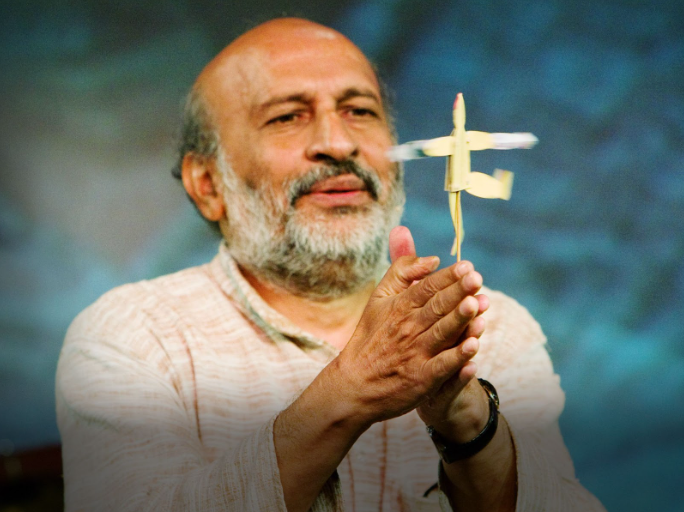
For renowned Indian science educator, innovator, toy inventor, and head of the Children’s Science Centre in the Inter-University Centre for Astronomy and Astrophysics (IUCAA), Arvind Gupta, the ‘Knowledge for Free’ movement is something worth dreaming and striving for. “Today, we can make every single book in every single language available to every single child on the earth. That is something worth striving for. There are a few public libraries in India, but our children hunger for knowledge. If good books are made available, they will benefit from it,” says Gupta.
Today, his website consists of 4,000 books on education, environment, science, maths, and children’s literature. Almost 15,000 books are downloaded each day across the globe from his website. Besides designing fun toys and simple science experiments, Gupta makes two-minute videos and uploads them on his website.
“Today, we have 4,400 videos in 18 languages, and 40,000 children worldwide view them every day. Over three crore children and teachers worldwide have viewed our videos in the last five years,” says Gupta.
Creation of learner’s library
Gupta and his team have also compiled a DVD titled The Learner’s Library for teachers in small towns without Internet access. “It contains 900 wonderful books, 7000 photographic instructions to make low-cost science models, and 200 videos of “Toys from Trash’.
And it costs less than Rs 15 for a blank DVD! Over 700 schools
are using this DVD. The Learner’s Library is circulated freely in South Africa, Nepal, Pakistan, Ghana, and other countries. Last year, an organisation in Gujarat made 1000 copies of The Learner’s Library and gifted them to local schools.”
Gupta agrees that in printing books that are not easily accessible or over 25 years old and copyrighted, there have been some instances where people have issued copyright notices to him.
However, he has a straightforward method of dealing with them. “If we get a notice, we apologize for the inconvenience caused and remove the book. However, by that time, many thousands have had already downloaded the book, thus fulfilling our task. We make no money on these books and share them with people who have no access to them. This is what the Internet was designed for to share,” he says.
According to Gupta, who is instrumental in popularising the concept of making knowledge freely available for one and all, “Every human being has a desire to contribute meaningfully to society. This desire to share is deeply encoded in human nature. It is only a matter of time before all books in all languages are available for free and accessible to anyone who seeks knowledge. I am waiting for that day,” he says in a tone full of hope and conviction.
Did you know?
- In 1971, pioneer Michael Hart set up Project Gutenberg (PG), the world’s oldest digital library, to divide and share e-books for free.
- Along with its partners and affiliates, PG, over the years, has managed to upload over 1,00,000 books on the Internet. With a slogan that reads, ‘A million books for a billion people’, the project has been a source of deep inspiration for millions across the world and has used cutting-edge technology, not for personal gain but for public welfare – to allow books to be accessed by millions of people.
- In 1993, Microsoft bought all the world encyclopedias to set up Encarta – a digital encyclopedia. In 2003, Richard Stallman envisioned a free online encyclopedia ‘for the people, by the people.’ The result was Wikipedia – the largest multilingual repository of information in the entire world. The Massachusetts Institute of Technology (MIT), too, is playing an integral role in the movement by placing all its course content online for free. Today, the most inspiring talks on earth – the TED talks (ted.com) – can also be freely downloaded.